Last updated on March 13, 2018, 8:54 AM
The ITB 2017 in Berlin – and the online marketing topics from the tourism industry
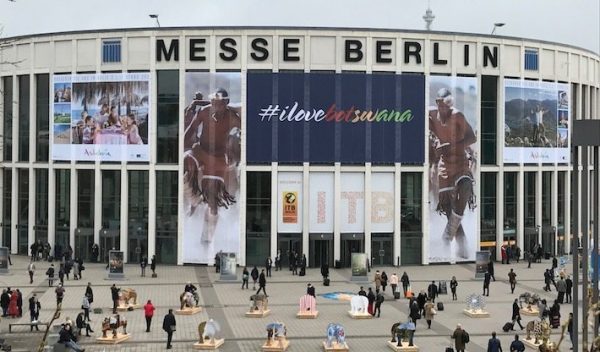
In 2017 I made it to the ITB (International Tourism Exchange) in Berlin for the first time. At the beginning I didn’t really know what to expect from the conference program, but I have to say I was very positively surprised and was able to take a lot with me on the topic of digital tourism marketing 2017.
The entire ETravel World section with the ETravel Lab and the ETravel Stage offered top-class specialist lectures from which you could take away a lot as an online marketer.
A major focus was also on the topic of influencer marketing in tourism. What was also very interesting for me personally was the second big chunk with the tourism industry’s increasing automation efforts in terms of customer service. Here they clearly rely on chatbots and AI (Artificial Intelligence) in the background.
Here is a small excerpt from the lectures that I found particularly good:
Table of Contents:
Digital rock stars in tourism by Toni Stork The Future of Travel Booking from Voyagessncf.com Emotional Storytelling & Content Marketing in Tourism with Visit Finland Summary of ITB 2017
Digital Rockstars in Tourism by Toni Stork (OMMAX Agency)
I was a little skeptical at the beginning because it started out quite agency-heavy, but the examples and detailed description of why each of the companies/brands presented represents a best practice example in the respective discipline were very impressive and in-depth.
But who are the digital rock stars in tourism according to Ommax in German-speaking countries and what can you learn from them?
FTI as best practice in the area of: Organic search
We achieved an incredible increase in digital visibility (Google search ranking) from 2016 to 2017. They managed the whole thing with a strategy that relied heavily on individual content production. They picked out core topics of a holiday trip such as “general information”, “culinary”, “activities” and more about the respective destination. Content was then produced for each destination on these core topics.
Furthermore, a lot of UCG (user generated content) was generated through user reviews, which of course also led to a longer stay on the site for other users (reading the other users’ reviews).
The information architecture of the FTI site is also well thought out and guides the user well to the offers depending on their ideas.
Another sticking point is the intensive use of trust or social signals. Seal of quality as far as the eye can see :). But that convinces the users and gives security and of course further options for presentation in the SERPs (Search Engine Results Page) with nice asterisks :)
FTI Touristik also looks at networking with other strong sites such as Sonnenklar.tv, Fly.de, and much more. Of course, these all fit well with the topic of travel and provide Google with good “signals” and improve the ranking.
And at FTI, when indexing the pages, care is taken not to get the URL parameters into the Google index. What does that actually mean? “Filter parameter pages” that are accessed by user queries contain many URL parameters to display the search result for the user. For example, a specific product page can be reached in different ways depending on what you were looking for or which parameters you selected. An example:
www.travelsite.com/Category.html?price=300000 www.travelsite.com/Category.html?theme=247 www.travelsite.com/Category.html?size=240
always shows the same product.
However, these pages are theoretically duplicate content, which, as we all know, Google doesn’t like at all. But how can this happen now? For example, through filter boxes and filter dropdown selection fields that make it easier for the user to filter the search results. This causes the Google Bot to become extremely confused and unnecessarily indexes pages that are of no use to the user in the search results. Therefore, it is important to avoid indexing these parameter pages, and FTI has mastered this perfectly.
Booking.com as best practice in the area of: Paid search
It’s no secret that Booking.com does good online advertising, but here it was nicely shown where they focus and how well they actually master paid searches with Google Adwords.
Booking.com manages to create at least one ad per keyword and customize it there. Since there is an individual landing page for each keyword (e.g.: charlottenburg), you achieve a high quality factor and therefore have a good chance of landing in position 1 of the paid search ads.
 c) ITB 2017 Lecture – Toni Storck – Digital Rockstars in Tourism – Who is doing it right?
With the Adwords ads from Booking.com it is nice to see that everything that is possible is included. Reviews, sitelinks and additional information. This also makes the display as “large” as possible by using the maximum available and permitted characters that can be included.
 c) ITB 2017 Lecture – Toni Storck – Digital Rockstars in Tourism – Who is doing it right?
c) ITB 2017 Lecture – Toni Stork – Digital Rockstars in Tourism – Who is doing it right?
By fully utilizing the available characters of an Adwords ad, a particularly interesting mobile effect results for Booking.com.
 c) ITB 2017 Lecture – Toni Storck – Digital Rockstars in Tourism – Who is doing it right?
Mobile booking manages to cover almost the entire hit picture. You can’t see all the Adwords ads below at first glance. A very clever tactic and as a result a lion’s share of the clicks go to Booking.
TUI as best practice in the area of social media
Through great involvement on the channels Twitter and Instagram, TUI managed to overtake all other travel providers there. TUI is also strong on Facebook, but here Expedia is still way ahead. Nevertheless, Toni Stark impressively demonstrated that TUI uses its social media channels very well and has recognized exactly what users want.
How did this development come about?
- TUI consistently relies on audio visual content = images and videos of the best quality. 48% of postings are images and 50% are videos. There are almost no pure text or link postings anymore.
- Interaction is constantly kept high through many raffles
- The optimal posting frequency was determined for TUI and this is the frequency with which posts are made:
- 2 Facebook postings per day
- 2 Instagram postings per day
- 3 tweets per day
- And customer service is also excellent on Facebook with an average response time of 24 minutes for 90% of all Facebook inquiries.
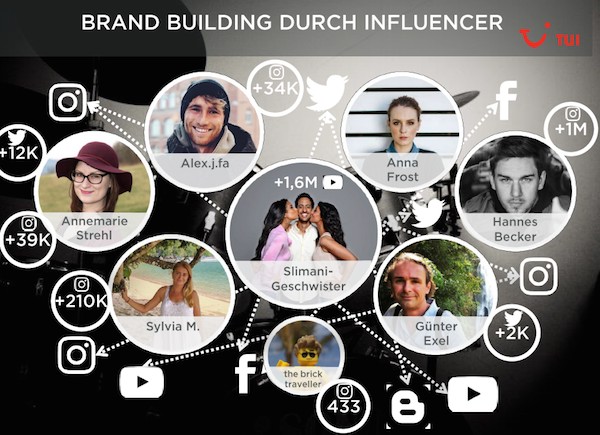
- Brand building through influencers
- TUI is not afraid to intensively involve influencers in their campaigns and thus also receive a good image transfer from the many (travel) bloggers/influencers
 c) ITB 2017 Lecture – Toni Storck – Digital Rockstars in Tourism – Who is doing it right?
TUI’s influencer marketing tries to cover a good mix of all channels and all topics in order to reach as many people as possible. Macro and micro influencers are also strongly combined here in order to have as little overlap as possible among the fans of the influencers who advertise for TUI.
The trend in 2017 is also clearly to integrate as many micro influencers as possible into the campaigns, as most of them have greater credibility than the really big influencers.
L’Tur as best practice in the area of affiliates & referrals
L’Tur was presented by Toni Storck as the best affiliate and referral travel provider. I wasn’t aware until now that L’tur gets so much traffic from affiliates, but apparently it’s 18% and that makes them the leader in Germany. Where does the traffic actually come from now? A total of 187 referrer sites, including high-quality sites such as Urlaubsguru, Trivago and Travelzoo. We didn’t get an insight into the exact compensation figures but I think it will be very lucrative for both sides and that’s why L’tur was able to build up this well-functioning network.
The entire presentation as a PDF by Toni Stork is also available on the ITB website -> here.
Update: A few days after I finished the blog post, the YouTube video for the presentation is now online.
The Future of Travel Booking by Voyagessncf.com
Arnaud Masson the COO of Voyages-sncf delivered an excellent presentation. The title of the lecture was actually: Smart Tourism: Knowing what customers want before they know it themselves, but it sounded even more like the future to me :)
Unfortunately, the slides from the lecture are not available as PDF, so here are just my highlights.
Voyagessncf has long offered a perfect Facebook Messenger ticket purchase option. In general, they try to integrate the start-up spirit internally and in their developments and incorporate a lot of user feedback into all innovations. For the relaunch of their website, they conducted an online survey of 18,000 users so as not to forget any detail when planning the user experience, and their Amazon Echo voice assistant integration (since mid-2016) is absolutely awesome. Your booking integration with Amazon Echo makes it possible to book the train trip by voice and also make some changes and queries.
This development also corresponds to most of the other statements at the conference and in the lectures. The interfaces for travel booking will be increasingly reduced and language will become more and more important as a booking input. As a result, search queries will also change drastically in the search engines and the websites will also have to react to this with their content and the presentation of their content.
Update: Here, too, the entire video of the talk was online a few days after I finished the blog post.
Emotional storytelling & content marketing in tourism with Visit Finland
Unfortunately I wasn’t able to see this talk live, but at least the video of it is already online. With good best practice examples from Visit Finland. And the Finns always do cool things in digital tourism marketing :)
Summary of ITB 2017:
As already mentioned at the beginning, the ITB 2017 was highly informative with the top-class specialist lectures on online marketing topics in the tourism industry. I can only recommend everyone to take a look at it. The ticket price is actually extremely cheap for the quality offered and you can also take a lot of online marketing know-how with you for all other industries.
We would be very happy about a review of the blog post :)
[RICH_REVIEWS_SNIPPET]
[RICH_REVIEWS_FORM]