Last updated on March 13, 2018, 8:58 AM
The rapid rise of the Chinese social media platform WeChat
As explained in the first blog post about my China focus](</digitales-marketing-in-china/>), WeChat represents the spearhead of social media platform developments in China. But many people still scratch their heads when they hear the word WeChat and ask themselves what this thing actually is and can do. But here’s a little information about the origins and history of WeChat before we get to the functions.
Table of Contents:
The evolution of WeChat from 2011 to 2018 From messenger to all-rounder Video clips on WeChat in mobile messenger as early as 2011? The rapid increase in the number of users The big QR Code boom in 2012 Weibo has to slowly dress up warm - 2013 Gaming and mobile payment on WeChat WeChat Wallet and pay with your smartphone Pay services via WeChat app Taxi booking via WeChat since 2014 WeChat’s Other Incredible Features Lucky Money What does the future hold for WeChat in 2018 Too much text, it’s time for videos TL;DR (too long, didn’t read) - Summary of the rise of WeChat in China
The evolution of WeChat from 2011 to 2018
In 2011, the Chinese company Tencent set out to develop a messenger app that over the years became a copy of Facebook because Facebook is blocked in China. But the former copy quickly combined functions from Facebook, WhatsApp and other apps and thus overtook the former model student Facebook.
By 2011, Tencent had already enjoyed considerable success with its ICQ or the MSN Messenger-like tool QQ and the associated social network Qzone. At that time, QQ already had 780 million users with Qzone in China and the next step was the consistent focus away from desktops and towards mobile devices.
From messenger to all-rounder
At that time, there were already messengers from the largest telecommunications providers in China, but Tencent wanted to create a free, platform-independent tool and revolutionize the SMS (or mobile communications) market. In 2010, the two “Western” messengers Whatsapp and Kik were released, which were also freely accessible in China. This was practically the starting signal for Tencent and it was clear that something had to happen here.

Weixin (Chinese name for WeChat) was released on January 21, 2011 and had the basic functions for sending text messages, photos and voice clips, i.e. small audio files for asynchronous communication, on board. So far so good, there haven’t been any major innovations here yet, but improvements were made in August 2011.
Video clips on WeChat in mobile messenger as early as 2011?
Here is an example of Weixin’s rapid development. The function to send video clips via messenger was already presented in August 2011. Since most of China was currently switching from 2G to 3G, a special compression process had to be developed to make video transmission possible (except via WiFi).
This special compression meant that a 1-minute video clip could be shrunk to a size of 1 MB, meaning the function could also be easily used in 2G networks.
The rapid increase in the number of users
In March 2012, Weixin already had 100 million registered users. In April 2012, 14 months after publication, the time had come and an English name for Weixin was found - Weixin became WeChat in the Western world.
The big QR Code boom in 2012
In 2012, the big QR code boom came in China and WeChat also introduced functions for the first time that were more reminiscent of Facebook and the Facebook fan pages.
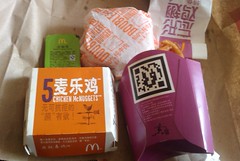 McDonalds was of course very early to start with the QR Codes in China.
Brand pages were developed and heavily promoted in order to quickly get as many companies, celebrities and large media houses on board as possible in order to be able to get in closer contact with consumers, similar to Facebook. The QR code led directly to the WeChat brand account and was placed wherever there was only one free space.
Weibo needs to warm up – 2013
In September 2012, WeChat already had 200 million users and in January 2013 there were already 300 million users. This also brought the next function into play, which was strongly based on the Facebook Stream, WeChat Moments.
In February 2013, Weibo (Twitter’s equivalent) had to admit defeat to WeChat as the Chinese people’s favorite social media app for the first time.
Gaming and mobile payment on WeChat
With the constant focus on Facebook, WeChat also started offering games directly on the platform in August 2013, but another important innovation became noticeable. WeChat Wallet was launched and this payment system laid the foundation for the mobile e-commerce revolution in China.
WeChat Wallet and pay with your smartphone
In order to slowly familiarize users with the payment system, there were initially more and more machines in the subway stations where you could easily pay using WeChat Wallet.

Due to the simplicity of paying directly in the WeChat app, the big brands started to take notice.
The large Chinese technology manufacturer Xiaomi started a field test in November 2013 to sell the new smartphone model exclusively via WeChat. An incredible 150,000 units were sold in 10 minutes. And thus began the success story of the WeChat sale offers, which repeatedly made international headlines over the next few years with incredible sales figures.
Of course, the online wholesaler Alibaba (Amazon counterpart) must also be mentioned here, which is always in the media with insane sales records.
Pay for services via WeChat app
But it wasn’t just drinks and snacks that could be paid for with the WeChat payment function. Other services and providers quickly followed. Movie tickets, electricity bills, buying stocks, booking vacations, airline tickets and many more joined the illustrious list of things and services that you could buy and pay for directly in WeChat. An Amazon for everything imaginable that can be purchased slowly emerged.
 c: David Dennis (Flickr)
Not only can amounts of money be transferred to companies, the WeChat Wallet also made it possible to easily transfer money between people on WeChat. The functions that we know from Number 26 / N26 (Moneybeam) and other fintechs such as Transferwise, Lendstar etc. for moving money directly between users were available on WeChat very early on.
This video (produced with a little budget) explains in an amusing way what else you can use WeChat for and also gives a little insight into shopping habits in China :)
Taxi booking via WeChat since 2014
In January 2014 the time had come and taxi bookings were also possible via WeChat. The cooperation with the Uber-like service Didi made this possible. The special highlight is that you can also pay for the taxi ride with your WeChat wallet. So everything is possible in one app :)
Here are a few more functions explained in the Business Insider video from 2014, in which you can see a heavy user’s daily usage behavior of the super app:
WeChat’s other incredible features
A very innovative function is the shake function, where you shake your smartphone and thereby trigger certain functions in the apps. One variant is the random chat function with people who are nearby :). Often used in bars and when going out to meet new people.
 WeChat Shake
Lucky Money
The shake function was first introduced in connection with “Lucky Money” by Tencent. Due to the Chinese tradition of giving away red envelopes with money for the New Year, the company came up with the idea of simply digitizing this tradition in their app for the New Year 2014. This made it possible to send the red envelopes and thus the gift of money digitally.
An interesting gambling variant also developed from the “Red Envelopes”. In a group chat, it is also possible to send an amount of money to the group in a red envelope and have the amount of money distributed using a random generator. This created a lot of tension and you could achieve an incredibly big psychological effect with the little red envelope on the display :)
Since China is a very large country and many people’s relatives live abroad, this digital version quickly became incredibly popular among users. Here is an interesting article about Lucky Money in New York and the promotional campaign for it.
There are tons of functions that are also very interesting and useful, but that would go beyond the scope here, more on that in the next blog posts. Until then, it’s best to subscribe to the newsletter so you don’t miss anything :).
[btnsx id=”817″]
What does the future hold for WeChat in 2018
At the end of Q3 2016, WeChat had 846 million accounts (active users per month). Facebook has been copying functions from WeChat for several years and due to its increasing dominance in the Chinese market, it will be interesting to see whether the first complete WeChat operating system will soon be on the market. The integration of your own apps in the app and brand worlds is becoming increasingly sophisticated and diverse (keyword mini apps). Similar to Facebook with Instant Articles, it goes even further in the direction of keeping the user on the platform and offering them everything they could wish for.
The only thing that hasn’t really worked out for WeChat is conquering the international market. But here too, it remains exciting to see what experiments Tencent will launch.
Too much text, it’s time for videos
After so much text, here is a very good video from February 2016 produced by China Channel:
The background to why WeChat was able to develop so quickly and achieve this immense market penetration is also beautifully presented here. Largely due to the size and nature of China and its population and the need to have a tool to stay in touch with family and friends who are thousands of miles away.
The big problem of “alienation”, i.e. the loneliness of many people in big cities, is also addressed and how WeChat also offers a solution for this :)
And here is an incredibly well-produced video from the New York Times that nicely summarizes practically everything that has already been explained :) China and the change from being the copy world champion to being a pioneer in social media and internet developments. A window into the future, so to speak. The presentation of what you can do within the app without having to think about using another app is particularly good. But the NY Times also takes a more critical look at the incredible amount of data that Chinese users reveal to WeChat and raises the question of what happens / or could happen with this data.
TL;DR (too long, didn’t read) – Summary of the rise of WeChat in China
In 2011, the tech company Tencent launched WeChat in China with the focus on developing the best mobile app for communication. Initially with few functions and based heavily on Whatsapp and Facebook, the app soon developed into a super app with an extremely large number of useful and well-thought-out functions that made life in China easier.
With the introduction of the payment function in the app and the smooth connection to the bank account, WeChat was no longer unstoppable. Through these clever developments and the precise analysis of the “needs” of Chinese society, WeChat became immensely popular. Today, the majority of Chinese people can no longer imagine life without WeChat and, as already mentioned, there are many indications of their own WeChat mobile operating system.
You will find out here in the next few weeks how WeChat can be used specifically for marketing measures and also specifically in the tourism sector.
And how can I implement the whole thing now or use WeChat - > just ask freshestweb :-)
We would be very happy about a review of the blog post :)
[RICH_REVIEWS_SNIPPET]
[RICH_REVIEWS_FORM]


](http://cdn2.i-scmp.com/sites/default/files/styles/980x551/public/2015/09/30/redred.jpg?itok=0cu8VW-9)